Where People Go Wrong
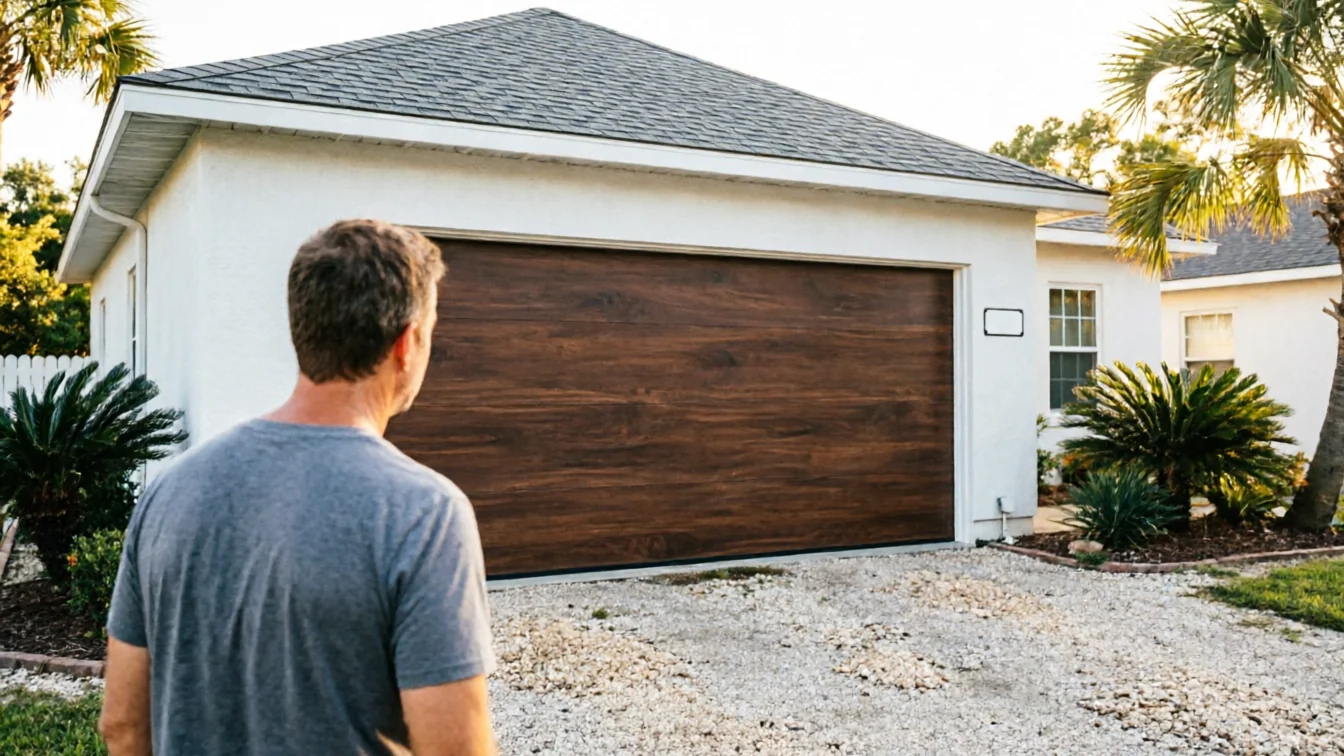
Most of the calls we get in Sanford come from houses built somewhere between 1966 and 2002, with the bulk of that stock dating to the 1980s and 90s. That matters more than people think. A door installed in, say, 1985 was built to a code that didn't ask much of it on the insulation side - thin steel skins, no foam core, bottom seals that were an afterthought rather than a requirement. Homeowners treat these doors like they're interchangeable with anything sold today. They're not. The track spacing, the spring sizing, even the way the panels hinge can be out of step with modern hardware, so a universal-fit opener or weatherstrip kit from a big box store sometimes just doesn't seat right. The other mistake we see constantly: people wait until a door won't open at all before calling anyone. On a door this age, a stiff track or a slow-closing panel is usually the spring losing tension gradually, not suddenly. By the time it won't budge, you're often looking at full spring failure and sometimes a bent track from the door trying to run crooked for weeks. Catching it at the 'it's getting slower' stage instead of the 'it's dead' stage is the single biggest difference in what a repair costs and how long it takes.
What the Weather Here Does to It
Sanford sits in a mild temperate band, so we don't get the freeze-thaw cycling that tears apart hardware up north, and that's the good news. The bad news is what mild-but-humid does to a door built before insulation rules existed: uninsulated steel skins sweat. Without a thermal break, the inside face of an older panel runs colder than the garage air on humid mornings, and condensation forms right where the hardware lives - hinges, the bottom roller brackets, the spring ends. Over years that's slow rust, not sudden failure, which is exactly why it gets ignored. On a newer insulated door this isn't much of an issue because the foam core keeps the inside skin closer to room temperature. On the pre-2000 stock that makes up most of this town, it's a steady, quiet cause of hinge and roller wear that shows up as noise long before it shows up as a breakdown. We don't see the ice-related spring snapping that colder climates deal with, so when a spring goes here, it's almost always fatigue from age and cycle count, not a cold-weather shock failure.
What It Costs
We're not going to hand you a number here that we can't back up for your specific door, because what drives the cost on a Sanford job is almost always the age of the house, not the brand of the door. A 1980s or 90s door usually means legacy hardware - spring sizes and track hardware that newer stock doesn't carry on the truck as standard, so a repair can mean a special-order part instead of a same-day swap. That's the honest limitation: if your door is original to a house built in that median-1984 window, don't expect every repair to be a same-visit fix. Sometimes it is. Sometimes the part has to come in. With a median household income around $80,775 across the area we work in, a lot of households are weighing repair against replacement on a door that's pushing 35 or 40 years old, and for a lot of those doors, replacing with an insulated model solves the condensation and hinge-wear problem permanently instead of chasing it every couple of years.
The Situation
Across the roughly 76,055 owner-occupied houses in the broader area we serve, a big share were built in that same 1966-2002 run, which means the garage door problem in Sanford isn't really about any one house - it's about a generation of construction hitting the same age-related failures at close to the same time. If you're near Midway, Lake Mary, or Heathrow and your house falls in that build window, the hinge noise, the slow roller, the spring that feels heavier than it used to - that's not bad luck, that's the hardware finishing out its service life on schedule. The doors built before insulation rules weren't built wrong, they were built to a different standard, and that standard just runs its course sooner than people expect.
Talk to a local pro
Garage door trouble in Sanford?
Same-day service with honest, upfront quotes.